
2026-05-12
SAP’s New API Policy Isn’t Just a Technical Update
SAP’s latest API policy is not just a technical clarification. It is a strategic statement about platform control, AI integration boundaries and the future shape of enterprise architecture.
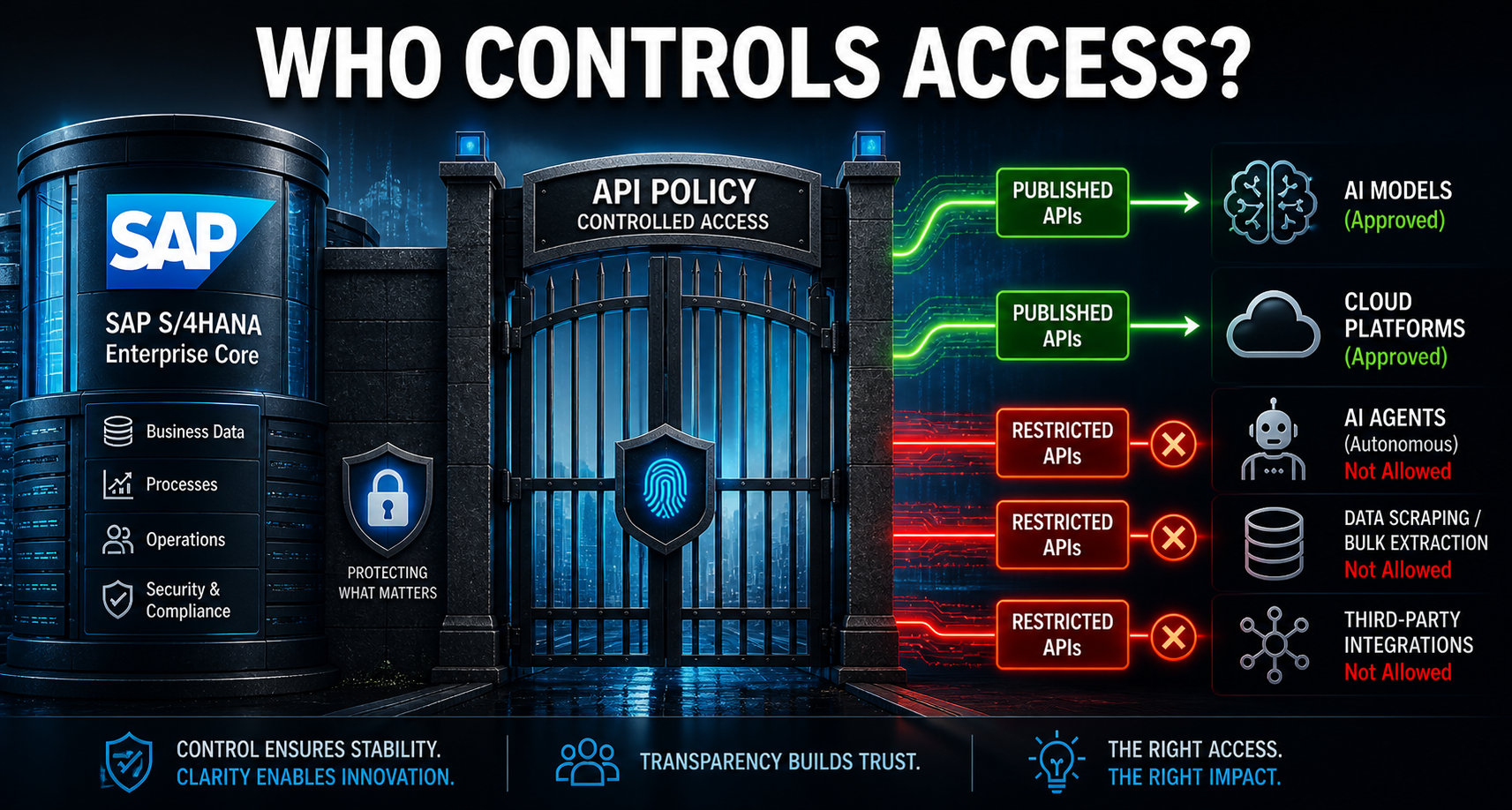
SAP’s new API policy isn’t just a technical update.
It’s a strategic statement about control.
And customers have noticed.
What SAP Is Actually Saying
On the surface, the policy is simple:
- Only APIs officially published in the SAP Business Accelerator Hub or product documentation are supported.
- Everything else?
- Off-limits.
SAP’s justification is equally straightforward:
- protect system stability
- ensure supportability
- avoid uncontrolled integrations
- maintain solution health
All reasonable.
Why Customers Are Pushing Back
The German-speaking SAP User Group's (DSAG) response highlights something deeper.
This isn’t just about APIs.
It’s about how much control SAP is asserting over customer architectures, especially in the context of AI.
Key concerns include:
- unclear contractual status of APIs
- lack of transparency on what is affected
- potential disruption to existing integrations
- uncertainty around future pricing models
- restrictions on AI-driven integrations
One line in particular stands out:
Restrictions on using APIs with generative or autonomous AI systems unless within SAP-endorsed architectures.
That changes the game.
The Real Issue: Innovation Boundaries
For many CIOs, APIs are not just integration tools.
They are the foundation of AI strategy.
They enable:
- extracting ERP data into data platforms
- feeding models outside SAP
- orchestrating workflows across ecosystems
- experimenting with new AI capabilities
Restrict that access, and you don’t just protect systems.
You shape where innovation can happen.
SAP’s Position (And Why It Exists)
Let’s be fair.
SAP is trying to solve real problems:
- uncontrolled data extraction
- fragile custom integrations
- support complexity
- performance risks
- security exposure
And now:
- AI agents making unpredictable API calls
- large-scale data scraping
- uncontrolled replication into external platforms
From SAP’s perspective, this is not theoretical risk.
It’s operational reality.
Where the Tension Lies
Customers are not asking for chaos.
They are asking for:
- clarity
- predictability
- contractual certainty
- transition paths
- architectural flexibility
Especially in a world where many have already invested in:
- Snowflake
- Databricks
- Azure / AWS ecosystems
- third-party AI platforms
The concern is simple:
Will SAP enable those strategies — or constrain them?
The AI Angle Changes Everything
This policy lands at the worst possible time.
Right when organisations are:
- experimenting with AI
- building pilots
- testing integrations
- exploring orchestration
Now they are being told:
Some of those approaches may not be allowed.
Or may only be allowed inside SAP-defined pathways.
That introduces:
- legal risk
- architectural risk
- investment uncertainty
The Pragmatic CIO View
This is not about choosing sides.
It’s about understanding reality.
SAP is moving toward:
controlled ecosystems with defined integration paths
Customers are moving toward:
open architectures with flexible AI integration
Those two models can coexist.
But only if SAP provides:
- clear API definitions
- stable contracts
- transparent pricing
- supported integration patterns
- realistic transition periods
The Uncomfortable Truth
Enterprise platforms win on trust.
Not just capability.
If customers feel:
- constrained
- unclear
- exposed to future pricing risk
- forced into specific architectures
They will adapt.
Not necessarily by leaving SAP.
But by building around it instead of through it.
Final Thought
This policy is not the problem.
Lack of clarity around it is.
In the age of AI, APIs are no longer technical plumbing.
They are strategic control points.
And whoever controls them shapes the future architecture.